
Estate-Level Food Safety Risk in Multi-Site Bakeries: The Hidden Exposure in 2026
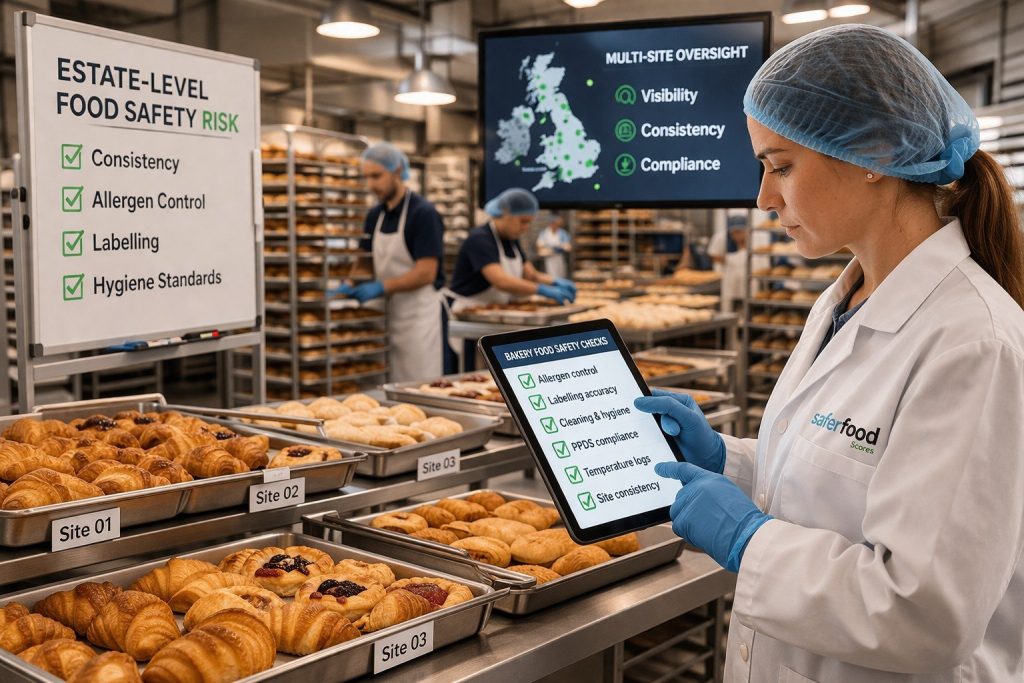
Bakery food safety risk in multi-site operations rarely begins with one catastrophic failure.
More often, bakery food safety risk develops gradually — through small inconsistencies between sites. An allergen check applied slightly differently. A label verified informally during a busy shift. A cleaning routine interpreted loosely under pressure. Head Office only gaining visibility once a complaint, inspection, or recall forces escalation.
According to UK Food Standards Agency (FSA) recall data, allergen mislabelling continues to be one of the leading causes of food recalls. Bakery and snack products regularly appear in public alerts — not because controls are absent, but because execution varies.
In 2026, estate-level food safety risk is increasingly defined by inconsistency rather than intent.
Why Bakery Food Safety Risk Is Increasing in Multi-Site Estates
Multi-site bakery groups face a convergence of pressures that amplify food safety risk:
-
Rising labour and employer costs
-
Ingredient and energy inflation
-
Greater regulatory scrutiny around allergens and PPDS
-
Heightened customer expectations around hygiene
-
Social media amplification of single-site incidents
Industry reporting from organisations such as the FSA and BRCGS shows food incidents are becoming more complex, often driven by supply chain fragility and operational intensity.
In this environment, estate-level food safety risk becomes harder to manage using traditional site-based approaches alone.
The Consistency Gap Across Multi-Site Bakery Estates
Most bakery groups have strong policies and documented procedures in place.
However, estate-level food safety risk increases when:
-
Allergen handling differs slightly between sites
-
PPDS requirements are interpreted inconsistently
-
Hygiene verification processes vary
-
Informal workarounds emerge during peak trading
-
Head Office lacks real-time visibility of high-risk activities
These differences may appear minor in isolation. Across an estate, they create systemic exposure.
UK recall case studies frequently show that undeclared allergens, incorrect packaging, and cross-contamination issues stem from operational drift rather than policy absence.
Estate-level food safety risk lives in that drift.
Traditional Audits vs Estate-Level Risk
Traditional food safety audits assess individual site compliance at a point in time.
They are essential. But they do not always reveal:
-
Variation between locations
-
Reliance on key individuals
-
Patterns of informal practice
-
Delayed escalation of issues
-
Weak central visibility
Estate-level food safety risk requires a different lens — one that looks at how controls behave across multiple sites simultaneously.
Leadership teams are increasingly shifting from asking:
“Are our sites compliant?”
To asking:
“Where is estate-level food safety risk building through inconsistency?”
Regulatory and Reputational Exposure in 2026
Estate-level food safety risk now carries greater consequences than in previous years.
-
Natasha’s Law has increased allergen compliance expectations
-
Local authorities are focusing on hygiene and allergen control
-
Poor FHRS scores directly affect footfall
-
Social media accelerates reputational damage
For multi-site bakery operations — where products are allergen-heavy, short shelf-life, and highly visible — even minor failures can have disproportionate impact.
Industry recall reporting demonstrates that everyday products, not niche items, most often trigger incidents.
Reducing Estate-Level Bakery Food Safety Risk Through Visibility
One of the most consistent themes emerging in estate-level food safety risk is delayed visibility.
Head Office often becomes aware of issues only after:
-
An inspection identifies a gap
-
A complaint escalates
-
A hygiene rating drops
-
A recall is initiated
Improving estate-level visibility — rather than simply increasing audit frequency — is becoming central to effective food safety risk management.
Moving from Compliance to Consistency
Forward-looking bakery groups are shifting from compliance-driven assurance to consistency-driven risk management.
The focus is increasingly on:
-
Identifying operational drift early
-
Reducing variation between sites
-
Strengthening execution of existing controls
-
Improving central line-of-sight on high-risk activities
Estate-level food safety risk cannot be eliminated. But it can be managed more intelligently.
Final Reflection on Estate-Level Food Safety Risk
Most bakery recalls are preventable.
Most food safety failures begin with variation.
In multi-site bakery estates, consistency is not just an operational objective — it is a strategic safeguard.
As regulatory expectations tighten and margins narrow, estate-level food safety risk will increasingly define resilience across the UK bakery sector.
Where Is Bakery Food Safety Risk Building in Your Estate?
Most risks don’t sit in policy — they sit in variation between sites.
If you don’t have clear visibility of how controls are actually being applied across your estate, you may already have exposure.
We work with multi-site bakery groups to identify where food safety risk is developing through inconsistency before it escalates.
If you need extra support with your bakery operations, get in touch — we’ve been proudly supporting bakery businesses with food safety and compliance since 2010.
Lucy Fleming
Commercial Director | Safer Food Scores
📧 Lucy@saferfoodscores.co.uk
📞 01442 877322
🌐 www.saferfoodscores.co.uk
⭐ Rated 4.8 on Trustpilot
👉 Speak to us for a focused review of your highest-risk areas.