
Compliance Risks for Managers: What Keeps You Awake at Night?
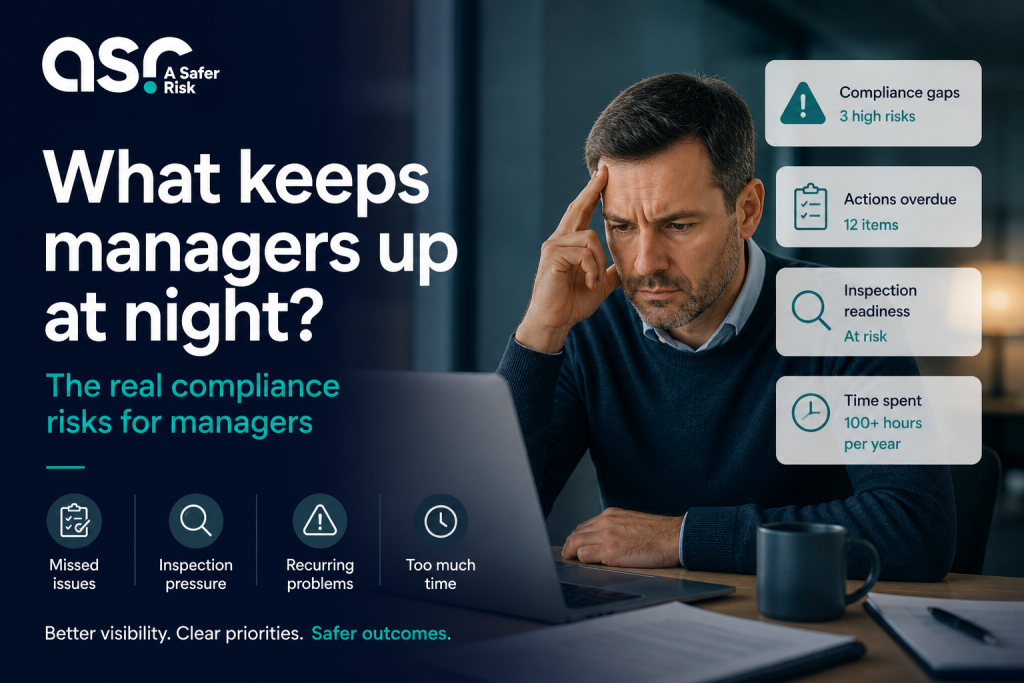
Compliance risks for managers rarely come from what you can see. They come from what gets missed.
In sectors like hospitality, childcare and adult social care, managers complete audits, file reports and log actions every day.
However, the real challenge is not completing tasks. Instead, it is knowing whether anything has been overlooked.
This is where the biggest compliance risks for managers sit.
What are the biggest compliance risks for managers?
The biggest compliance risks for managers include missed issues, repeat problems, failed inspections and unclear priorities.
These risks often arise when information is spread across multiple systems, difficult to interpret or not clearly prioritised.
As a result, important issues can be overlooked, leading to risks to health, safety and organisational reputation.
Signs your organisation may have hidden compliance risks
You may have hidden compliance risks if any of the following sound familiar:
- You rely on multiple systems that do not connect, such as Excel, Word, audit tools, care systems or manual files.
- Your suppliers use a mix of paperwork and digital reports, making information difficult to track and compare.
- Inspections and maintenance happen at different times throughout the year, so it is hard to maintain a clear, up-to-date view.
- More than one person manages compliance, for example a manager and an owner, which can lead to gaps or duplication.
- Communication is fragmented across emails and systems, so it is unclear what has been shared and what has been missed.
- You see the same issues repeated in inspections or audits, but the root cause is never fully addressed.
- You struggle to decide what to fix first because everything feels important.
- You often catch up on compliance work after hours or at weekends when you are already tired.
- Your team finds reports technical and difficult to understand, and suppliers often hide risk behind complex language.
- You feel unsure about inspection readiness, especially if it has been a long time since your last inspection or you have not been inspected before.
- Multiple regulators with multiple agendas such as the Local Authority inspecting Food Standards, Ofsted inspecting education or CQC inspecting care.
The most common compliance risks managers face
1. What if something has been missed?
Teams often spread compliance information across audits, contractor reports, training records and maintenance logs.
As a result, managers cannot always see the full picture.
Important risks can sit inside reports. In other cases, teams pass information between departments. Sometimes, people overlook key issues completely.
The biggest risk is not what you know. It is what you do not see.
2. Why do the same issues keep coming back?
Many businesses face repeat problems. For example, inspections often highlight the same issues again and again.
This happens because teams manage issues in isolation. They do not connect patterns or fix root causes.
Therefore, the same risks continue to return.
3. What should managers prioritise first?
Managers deal with long action lists, competing priorities and limited time.
However, most systems show everything at once. As a result, they do not highlight what matters most.
So managers often ask: what should I fix first?
4. Will we pass our next inspection?
Inspections create pressure. They can lead to action from regulators, damage to reputation and disruption to services.
In many cases, managers review large amounts of data. They check actions manually and rely on judgement.
As a result, inspection readiness often feels uncertain.
5. Do teams understand compliance requirements?
Most compliance reports are long, technical and difficult to engage with.
In reality, they are often seen as boring and dry rather than useful.
Because of this, teams do not always read them properly or fully understand what is required.
As a result, important actions can be missed, misunderstood or not followed through.
This means the risk is not just in the report itself, but in how people respond to it.
6. How much time is spent managing compliance?
Managers spend a lot of time reviewing reports, checking findings and chasing actions.
In many cases, this adds up to more than 100 hours per year.
However, this is rarely planned time. It is often borrowed time.
Compliance work is pushed into gaps in the day, picked up after hours or dealt with at weekends when managers are already tired.
As a result, compliance becomes reactive rather than controlled.
This means managers are not just losing time. They are losing focus, energy and confidence in what has or has not been done.
Why compliance risks for managers are increasing
Compliance risks for managers are not just increasing because of more rules. They are increasing because the environment around compliance has fundamentally changed.
Firstly, compliance requirements have grown significantly. The expansion of regulations, particularly following closer alignment with European standards, has increased both the volume and complexity of what organisations must manage.
At the same time, expectations have risen. Regulators, customers and stakeholders now expect higher standards, faster responses and clearer accountability.
Social media has also played a role. Issues that may once have gone unnoticed can now quickly become visible, shared and scrutinised. As a result, the reputational risk of getting compliance wrong is much higher.
However, while expectations and complexity have increased, many systems and processes have not kept pace.
Managers are now expected to manage more data, more regulations and more responsibility, often without better tools or clearer visibility.
As a result, managers face more pressure, less clarity and a greater risk of missing something important.
Why traditional approaches increase compliance risks
Most systems record activity and store documents. However, they do not give clear insight.
For example, they do not connect data, spot patterns or highlight key risks.
Because of this, managers have data but lack clarity.
How to reduce compliance risks for managers
Managers can reduce risk by improving visibility, connecting data and focusing on the most important actions.
This means moving beyond recording compliance and understanding risk.
When managers clearly see what matters most, they can act faster and with confidence.
How better visibility reduces compliance risks
When systems connect and interpret data, managers gain a clear view of risk.
They can find issues earlier, focus on priorities and feel more confident.
As a result, organisations reduce both risk and pressure.
How to prepare for compliance inspections
Managers can reduce risk by preparing early for inspections. This includes reviewing actions, checking records and ensuring teams understand their responsibilities.
In many cases, preparation is not about doing more work. It is about having clear visibility of what matters most.
Final thought
Compliance will always be important.
However, the biggest risk for managers is not non-compliance. It is uncertainty.
Not knowing what has been missed. Not knowing what matters most. Not knowing if you are truly inspection-ready.
Reducing that uncertainty is what creates safer, more effective organisations.
And you no longer have to manage it alone.
A simpler way to manage compliance
A Safer Risk is a compliance platform designed by managers, for managers.
It helps you move from chasing tasks to staying in control, so you spend less time managing compliance and more time completing it.
Instead of working in spreadsheets, reports and disconnected systems, everything is brought together in one clear view.
This means you can focus on what matters, act earlier and feel confident nothing is being missed.
What makes Safer Risk different
✔ Quick to set up, with sector-specific tools ready from day one.
✔ Simple and intuitive to use, so your team does not need lengthy training or manuals.
✔ A visual dashboard that clearly shows what needs attention and prioritises actions based on risk.
✔ One place for all compliance information including daily checklist, maintenance, audits, reports and inspections.
✔ A central document store for all policies, reports, audits and records.
✔ Designed by managers with over 20 years of experience across care, hospitality and food safety.
✔ Clear tracking of improvement over time, motivating for the team and helping demonstrate progress during inspections.
✔ AI-assisted tools that read lengthy reports, identify actions and highlight what may need further investigation.
Ultimately with everything in one place, risk becomes visible — and compliance stays on track.
Take control of your compliance
Want to stop second-guessing your compliance and feel confident nothing is being missed?
See how Safer Risk works in practice and how quickly you can get started.
Get in touch today.
FAQs: Compliance risks for managers
What are the biggest compliance risks for managers?
The biggest risks include missed issues, failed inspections, repeat problems and unclear priorities.
Why do compliance issues keep recurring?
Issues return because teams do not connect patterns or fix root causes.
How much time do managers spend on compliance?
Managers can spend over 100 hours each year reviewing compliance information.
How can managers reduce compliance risks?
Managers can reduce risk by improving visibility, connecting data and focusing on what matters most.
Reduce compliance risk with better visibility
Want to stop second-guessing your compliance and feel confident nothing is being missed?
See how A Safer Risk helps managers identify risks, prioritise actions and stay inspection-ready.
Get in touch to see how it works in practice.