
A practical guide for restaurants, pubs, hotels and caterers
Lunch is running over. The next party is due in 20 minutes, a delivery has arrived with a different gravy and the kitchen still needs time to reset. Who checks that the replacement can be used? Who decides whether to seat the next group?
Christmas puts familiar safety controls under pressure. More guests, larger batches, seasonal menus, temporary staff, extra suppliers and outside caterers all need to fit into the same operation. Walk the plan from delivery to service and check where the usual way of working will stretch.
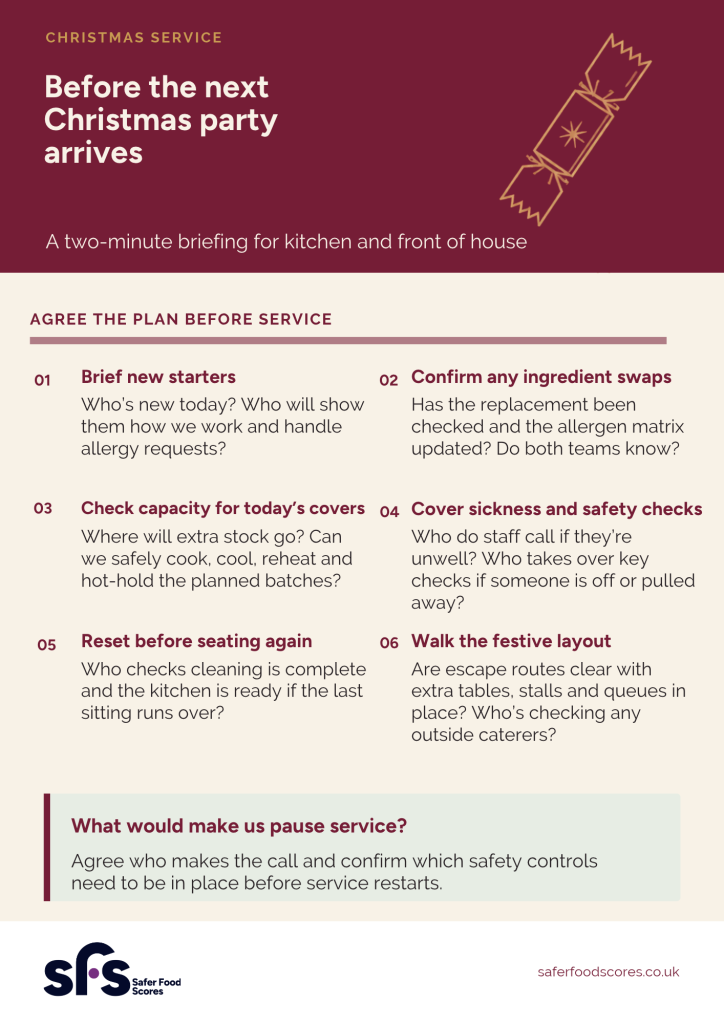
Download the free Christmas briefing poster (PDF)
Print it for your staff area and use the six prompts with the kitchen and front-of-house leads before service. No sign-up needed.
1. Can your kitchen handle the biggest Christmas sitting?
Work through the busiest day against your food safety management system and HACCP controls. Use your expected covers, menus and booking times to test the plan. Check oven loads, the amount you can cool at once, available fridge space and the capacity of your reheating and hot-holding equipment. Include breaks and handovers when you allocate each check.
Turkey is a useful test. If it is going straight to service, can you cook each batch safely and hold it at the right temperature? If you’re cooking ahead, can you cool it promptly, store it safely and reheat it thoroughly before service? Give gravy and other large batches the same attention. UKHSA identifies bulk-cooked meat and gravy as foods associated with Clostridium perfringens food poisoning. Spores can survive cooking, and the bacteria can multiply when food cools slowly or is held at unsuitable temperatures.
- Prepare and cook. Separate raw poultry from ready-to-eat food and use a two-stage clean wherever there is any crossover. Use a clean, disinfected probe to verify the core temperature at the thickest point or a representative cold spot. The FSA recommends 75°C for 30 seconds as a standard target for poultry, minced meat and reheated food.
- Serve or hot-hold. Preheat suitable holding equipment and check the food itself. The FSA’s standard hot-holding threshold is 63°C or above. Decide who monitors it and what happens if readings fall outside your limits.
- Cool and store. If you’re cooking ahead, use the cooling method and limits in your food safety system. Use smaller portions, shallow containers or a blast chiller as appropriate. Confirm that you can chill the entire load promptly without warming other food when you put it into chilled storage. Label, date and store the food in line with your policies.
- Reheat for service. Reheat thoroughly according to your procedure and verify the core temperature where required. Reheat only once. The FSA recommends 75°C for 30 seconds. For Scottish sites, use Food Standards Scotland’s CookSafe guidance on the 82°C reheating requirement and applicable exceptions.
If your trial run shows that the equipment or space can’t cope, reduce batch sizes, stagger prep or change the menu or service plan. Agree the fallback before taking extra bookings. If a check fails during service, hold the affected batch and follow your corrective-action procedure before deciding whether it can be served.
FSA cooking and hot-holding guidance · Food Standards Scotland CookSafe · UKHSA guidance on Clostridium perfringens
2. What do seasonal staff need to know before they start?
An experienced agency worker can still be new to your site. Give each new starter a practical induction where they’ll work. Cover handwashing and sickness reporting, separation of raw and ready-to-eat food, safe cleaning and disinfection, allergen enquiries, and the checks they’ll actually perform. Show them how to report an incident, where the exits are and what to do if the alarm sounds.
Name a buddy and identify tasks that need supervision. Ask the person to show you what they’d do if a guest reported an allergy, a delivery arrived with a substitute or a temperature check failed. Record the induction and hand over any training still needed to the next shift lead.
FSA Safer Food, Better Business for caterers · HSE temporary worker guidance
3. Does the allergen information match what you’re serving today?
Check festive specials, sauces, garnishes, drinks and party menus against current recipes and specifications. Keep one current allergen matrix where kitchen and front-of-house staff can find it. Make each update visible, take outdated copies out of circulation and brief both teams before the change goes live.
For loose food, make information on the 14 regulated allergens available. The FSA recommends written information supported by a conversation. Agree who checks the current information, how the kitchen receives and confirms an allergy order, and who gets the correct dish to the correct guest. Check cross-contact risks such as shared utensils, trays and fryer oil. If you cannot verify the ingredients or safely manage the order, tell the guest and only offer an alternative you can verify.
For festive takeaway items, check how they are sold and packed. Food that is prepacked for direct sale (PPDS) needs the food name and a full ingredients list with regulated allergens emphasised. Check the applicable labelling requirements for any other prepacked items.
FSA allergen guidance · FSA PPDS labelling guidance
4. What happens when a different product turns up?
A different brand of gravy can look interchangeable on the invoice. Hold it while the nominated person confirms that the supplier is approved and the replacement meets your product approval criteria. Compare the replacement’s label and current specification with those of the approved product. Check the ingredients, allergen information and any changes to storage or preparation. Check for changes even when the brand or product name is familiar.
If the replacement is approved, update the recipe, allergen matrix, menus and labels wherever affected. Tell the kitchen and front of house before anyone uses it, and recheck any allergy orders already booked. If the team cannot verify or communicate the change in time, keep the item off the menu until it can.
In December 2025, the Food Standards Agency published an alert after Aldi recalled a festive party-food product containing egg that was missing from the label. It’s a real example of how much customers and teams rely on accurate product information.
FSA December 2025 allergy alert
5. Where will extra deliveries, stock and waste go?
Walk the site before ordering. Confirm capacity for chilled, frozen and ambient stock, including any temporary storage. Leave room for air to circulate and keep raw food separate from ready-to-eat food. Where a fridge is shared, keep raw food covered and below ready-to-eat items. Check use-by dates, stock rotation and traceability.
Book extra deliveries away from service where possible and name who will check and put them away. Check temperatures where relevant, packaging, dates and substitutions against your acceptance procedure. If a delivery fails your checks, follow the site’s rejection procedure. If the walk-in is already full, stagger deliveries or adjust the order.
Plan a clear route for moving stock and waste without crossing busy guest areas where practicable. Keep escape routes clear during unloading. Empty bins and arrange collections more frequently if needed. Check temporary stores, delivery areas and bins for signs of pest activity such as droppings, gnawed packaging or damaged stock. Report and investigate findings promptly.
FSA pest-control guidance for caterers
6. Who checks that the kitchen is ready for the next sitting?
Protect a reset window between services. Name who will clean and, where required, disinfect food-contact surfaces, equipment and utensils before reuse. Follow the product instructions for dilution and contact time. Make sure there are enough clean cloths, the handwashing stations are stocked, waste has been cleared and floors are safe.
If lunch overruns, the kitchen lead tells front of house what is outstanding. Agree in advance who can hold the next seating or keep a station out of use until the reset has been checked.
7. Who covers the shift if someone reports vomiting or diarrhoea?
Plan for winter illness before the bookings fill up. Norovirus spreads easily. Make sure all staff, including agency colleagues, know who to call if they develop symptoms before or during a shift.
Food handlers with vomiting or diarrhoea should report their symptoms immediately and be excluded from working with or around open food until at least 48 hours after symptoms have stopped naturally. The clock starts when symptoms stop.
Name a deputy for each critical check and plan what you can scale back if cover falls through. Explain the sickness reporting and pay arrangements in advance so staff know where they stand. Apply the same return-to-work decision across shifts, even when someone is worried about losing pay or the team is short.
Keep handwashing stations stocked and insist on effective handwashing with soap and water. Alcohol hand gel is ineffective against norovirus. If someone becomes ill on site, follow your incident cleaning procedure, protect food from contamination and use a suitable disinfectant as directed.
FSA food-handler fitness-to-work guidance · NHS norovirus guidance
8. What would make you pause service?
At a Christmas Day lunch in Hornchurch in 2012, a guest died and dozens became ill. In the resulting court case, prosecutors said the turkey had been cooked the previous day, inadequately cooled and improperly reheated. The case brings the capacity question into focus. Can the kitchen carry out its planned checks for every batch?
ITV News report on the Hornchurch Christmas lunch case
Give staff a clear first step when an ingredient can’t be verified, a fridge alarm goes off, a check is missed or an exit is blocked. Pause the affected dish, task or area and tell the duty manager. Keep any affected food out of service. The manager should check what happened, record the decision and verify the fix before restarting.
If potentially unsafe food has reached customers, follow your incident procedure immediately. Keep labels, batch details and records. Contact the relevant authority as required and act promptly on any withdrawal or recall. For suspected anaphylaxis, call 999 immediately and tell the operator you suspect anaphylaxis. Follow the call handler’s instructions.
FSA incident, withdrawal and recall guidance · NHS anaphylaxis guidance
Take two minutes before guests arrive
Before the first busy booking, look at last December’s complaints, near misses and actions. Pick one issue that could happen again and decide what you’ll change. Then use the briefing poster on each busy shift.
- Who is new today, and who is briefing them?
- What has changed on the menu or delivery list, and where will extra stock go?
- Who covers the key checks, and who signs off the reset between sittings?
- Have we walked the escape routes with the event layout in place?
- What would make us pause, and who makes that call?
Give anything outstanding an owner and a deadline. Use the briefing alongside your normal opening checks and keep the plan where both teams can see it. If a process depends on someone remembering a change mid-service, put that change into the checklist, recipe or handover.
What extra checks do you need for seasonal pop-ups, markets, Santa events and outside caterers?
Walk the venue once stalls, extra tables, decorations and coat rails are in place. Check the capacity for the actual layout. Look at queues, wet entrances, slip risks, temporary lighting and cables. Keep decorations away from heat and ignition sources. Make sure exits are immediately usable, signs and emergency lighting are visible, and the route stays clear all the way to a safe place. Review the fire risk assessment and any applicable licence conditions if the layout or use changes.
Checks for outside food traders
Before confirming a food stall, mobile trader or outside caterer, verify their food business registration with the relevant local authority and check any approval where applicable. Ask for their food safety arrangements, allergen information, evidence of insurance where required by the event and relevant risk assessments, including those for gas or electrical equipment where used.
Agree who supplies potable water, handwashing facilities, power, temperature-controlled storage and waste facilities. Check that traders can keep food safe in transit, on arrival and through service. Record who is responsible for each control, who will verify the setup on the day and who can stop trading or handle an incident. Confirm what the local authority or venue requires for your event.
Food business registration · Kirklees Council outdoor event food safety guide · HSE event safety guidance · Fire safety guidance for venues in England
Download the free Christmas briefing poster (PDF)
If you’d like a second pair of eyes on your festive plans, our Safer Food Scores team can review how your menus, equipment and team will cope with the bookings you’ve taken. A Safer Risk brings checklists, incidents and follow-up actions together so managers can see what needs attention across shifts and sites.