
The 7 Principles of HACCP Explained: A Simple Guide for Food Businesses
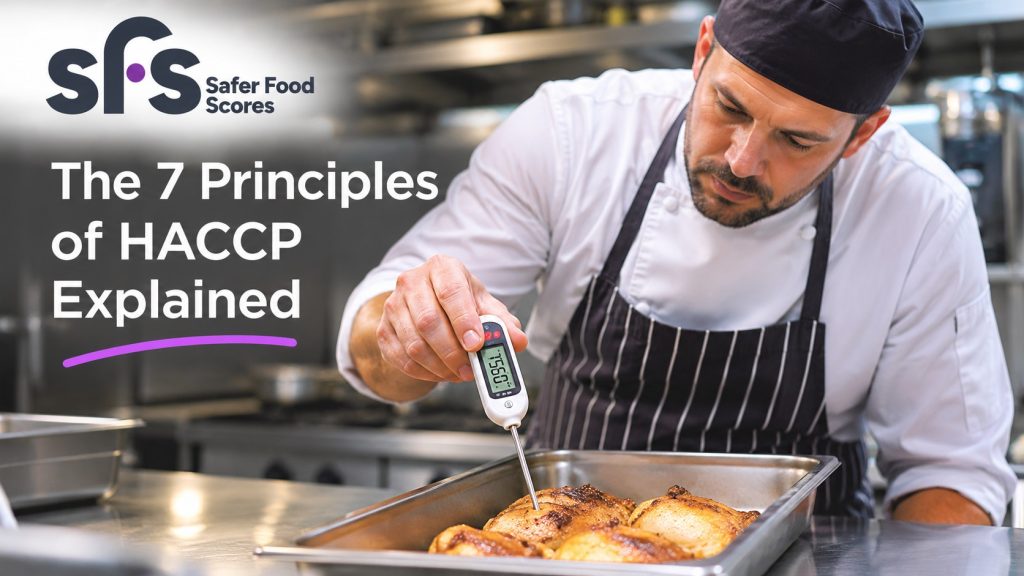
HACCP doesn’t have to be complicated. Whether you run a restaurant, café, bakery, hotel kitchen, care home or food manufacturing business, understanding the seven principles of HACCP is essential to managing food safety effectively.
But what do the seven principles actually mean, and how do you put them into practice?
In this guide, we explain each principle in plain English, with practical examples to help you understand how HACCP works in a real food business.
What is HACCP?
HACCP stands for Hazard Analysis and Critical Control Points.
It is a systematic approach to identifying, assessing and controlling food safety hazards before they cause harm.
Rather than relying solely on checking the finished food, HACCP focuses on preventing problems throughout food preparation, production, storage and service.
In the UK, food businesses are generally required to have food safety management procedures based on HACCP principles under food hygiene legislation. The complexity of these procedures should be appropriate to the size and nature of the business.
Put simply, HACCP helps you answer three important questions:
- What could go wrong with our food?
- What are we doing to prevent it?
- How can we demonstrate that our controls are working?
What are the 7 principles of HACCP?
The seven principles of HACCP are:
- Conduct a hazard analysis.
- Determine the Critical Control Points (CCPs).
- Establish critical limits.
- Establish monitoring procedures.
- Establish corrective actions.
- Establish verification procedures.
- Establish documentation and record-keeping procedures.
Let’s look at what each one means in practice.
1. Conduct a Hazard Analysis
The first principle is to identify what could make food unsafe at each stage of your operation.
Food safety hazards generally fall into four categories:
- Biological hazards: Harmful bacteria, viruses and parasites, such as Salmonella or Listeria.
- Chemical hazards: Cleaning chemicals, pesticides or other harmful chemical contamination.
- Physical hazards: Foreign objects such as glass, metal or plastic.
- Allergen hazards: Undeclared allergens or unintended allergen cross-contact.
Practical example: A restaurant preparing raw chicken needs to consider the risks of harmful bacteria, cross-contamination and inadequate cooking.
The business then identifies suitable control measures, such as separating raw and ready-to-eat foods, effective cleaning and ensuring chicken is thoroughly cooked.
The key question: What could go wrong, how likely is it, how serious could it be, and how will we control it?
2. Determine the Critical Control Points (CCPs)
A Critical Control Point is a stage where control is essential to prevent, eliminate or reduce a significant food safety hazard to an acceptable level.
Not every food safety control is a CCP.
Many hazards can be managed through good hygiene practices, staff training, cleaning procedures and other prerequisite programmes.
Practical example: Cooking chicken may be identified as a CCP because adequate cooking is essential to control harmful bacteria.
A structured decision-making process can help determine whether a particular stage should be classified as a CCP.
The key question: At which points must we apply essential controls to keep food safe?
3. Establish Critical Limits
Once a CCP has been identified, you need to establish a measurable or observable limit that distinguishes acceptable from unacceptable conditions.
Critical limits might relate to temperature, time, pH or another validated food safety parameter.
Practical example: A food business may establish a cooking critical limit of 75°C for 30 seconds at the centre of a chicken product, or another validated equivalent time and temperature combination.
The critical limit must be appropriate for the food, process and hazard being controlled.
The key question: What exact limit must be achieved to control the hazard?
4. Establish Monitoring Procedures
Monitoring means checking whether each CCP remains within its established critical limits.
Your procedures should make clear:
- What needs to be checked.
- How it will be checked.
- How often checks are required.
- Who is responsible.
- How the results will be recorded.
Practical example: A chef uses a clean, calibrated probe thermometer to check the core temperature of chicken at the required point in the cooking process.
Monitoring should be practical, consistent and sufficiently frequent to identify when a CCP is no longer under control.
The key question: How will we know that our critical controls are working?
5. Establish Corrective Actions
Even with good systems, things occasionally go wrong.
Corrective actions explain what staff must do when monitoring shows that a critical limit has not been met.
These actions should address both the affected food and the cause of the problem.
Practical example: A chicken dish has not reached the required cooking temperature.
The chef continues cooking and rechecks the temperature before service, provided this is consistent with the business’s validated procedure.
If the food cannot be made safe, it must not be served.
The business should also investigate why the critical limit was not met and take appropriate steps to prevent recurrence.
The key question: What happens when something goes wrong, and who is responsible for putting it right?
6. Establish Verification Procedures
Monitoring checks that controls are being followed. Verification checks that the HACCP system itself is working as intended.
Verification activities might include:
- Reviewing monitoring and corrective action records.
- Observing food handling practices.
- Checking thermometer calibration.
- Conducting internal food safety audits.
- Reviewing complaints and incidents.
- Reassessing the HACCP plan following changes to processes or ingredients.
Practical example: A manager reviews cooking records and observes food preparation to check that staff are following the agreed procedures.
Verification may also identify opportunities to simplify procedures or improve staff understanding.
The key question: How do we know our overall HACCP system remains effective?
7. Establish Documentation and Record-Keeping Procedures
The final principle is to maintain documentation and records appropriate to your food business and its HACCP system.
Documentation helps demonstrate how hazards have been assessed and controlled.
Depending on the operation, this might include:
- Hazard analysis and HACCP plans.
- Critical limits and monitoring procedures.
- Cooking or other CCP monitoring records.
- Corrective action records.
- Verification and review records.
- Relevant staff training records.
The aim is not to create paperwork for its own sake.
A good HACCP system should make food safety easier to manage, not create unnecessary administration.
For smaller businesses, simpler procedures and proportionate records may be appropriate. Larger or more complex operations may need more detailed documentation.
The key question: Can we demonstrate that our food safety controls are understood, followed and effective?
A Practical Example: HACCP in a Restaurant Kitchen
Let’s bring the seven principles together using a restaurant cooking chicken.
| HACCP principle | Practical application |
|---|---|
| 1. Hazard analysis | Identify harmful bacteria in raw chicken as a significant hazard. |
| 2. Critical Control Point | Identify cooking as a CCP. |
| 3. Critical limit | Establish a validated cooking temperature and time, such as 75°C for 30 seconds. |
| 4. Monitoring | Check cooking temperatures using a suitable probe thermometer. |
| 5. Corrective action | Continue cooking and recheck where safe and appropriate, or reject unsafe food. |
| 6. Verification | Review records, observe practices and check thermometer calibration. |
| 7. Documentation | Maintain the HACCP plan and relevant monitoring and corrective action records. |
This is a simplified illustration. A real HACCP plan must consider the business’s ingredients, equipment, processes, intended consumers and specific hazards.
What Is the Difference Between the 7 HACCP Principles and the 12 HACCP Steps?
This is a common source of confusion.
The seven HACCP principles form the foundation of the food safety control system.
The 12 steps of HACCP describe the wider process used to develop and implement a HACCP plan.
The first five steps are preparatory activities:
- Assemble the HACCP team.
- Describe the product.
- Identify the intended use.
- Construct a process flow diagram.
- Confirm the flow diagram on site.
The remaining seven steps apply the seven HACCP principles.
Both are important, but they serve slightly different purposes.
Common HACCP Mistakes to Avoid
Even well-established food businesses can develop gaps in their HACCP procedures.
Some of the most common problems include:
- Overcomplicated documentation: Procedures that staff struggle to understand or use.
- Too many CCPs: Treating every routine hygiene check as a Critical Control Point.
- Unclear responsibilities: Staff not knowing who should complete checks or take corrective action.
- Recording without reviewing: Collecting information without using it to identify recurring issues.
- Outdated HACCP plans: Failing to review procedures when menus, equipment, ingredients or processes change.
- Insufficient practical training: Staff knowing what forms to complete but not understanding why controls matter.
The most effective HACCP systems are built around how a business actually operates.
Frequently Asked Questions About HACCP
Is HACCP a legal requirement in the UK?
Food businesses are generally required to establish, implement and maintain permanent food safety management procedures based on HACCP principles. The requirements are proportionate to the nature and size of the operation, and flexibility is available for appropriate businesses.
Do small cafés and restaurants need HACCP?
Yes, they generally need HACCP-based food safety management procedures. However, smaller businesses may be able to use simplified approaches, such as the Food Standards Agency’s Safer Food, Better Business system, where suitable.
How many principles of HACCP are there?
There are seven HACCP principles. They cover hazard analysis, Critical Control Points, critical limits, monitoring, corrective actions, verification and documentation.
What is an example of a Critical Control Point?
Cooking chicken to a validated safe time and temperature is a common example of a CCP. Whether a particular process is a CCP must be determined through the business’s hazard analysis.
How often should a HACCP plan be reviewed?
A HACCP plan should be reviewed whenever changes could affect food safety, such as new ingredients, equipment, processes or menus. Periodic reviews are also good practice to ensure procedures remain effective.
Who is responsible for HACCP in a food business?
The food business operator is responsible for ensuring appropriate food safety management procedures are in place. Managers and employees also play important roles in implementing and maintaining those procedures.
Making HACCP Work in the Real World
Understanding the seven principles is one thing. Making them work consistently in a busy food business is another.
At Safer Food Scores, we believe food safety systems should be practical, proportionate and built around the people using them.
Our food safety consultants work with restaurants, hotels, bakeries, central production kitchens, care providers and other food businesses to develop and improve food safety management systems that work in practice.
Whether you need help reviewing an existing HACCP plan, developing new procedures, training your team or improving day-to-day compliance, we’re here to help.
Because good food safety isn’t about producing more paperwork. It’s about protecting customers, supporting your team and giving you confidence that your business is operating safely.
Safer Food Scores — Your Compliance Friend.
Need help with your HACCP or food safety management system?
Speak to our team to find out how we can support your business.
Other Valuable Sources