Compliance drift: why good businesses get caught out — and how to stay in control
Most serious compliance failures do not begin with someone deliberately ignoring the rules.
They begin with a missed check on a particularly busy day. A rushed handover. An overdue action that nobody follows up. A process that works well on paper but has gradually become difficult to follow in practice.
Each exception may appear small and understandable. The danger comes when those exceptions are repeated, accepted and eventually absorbed into the normal way of working.
That is compliance drift.
What is compliance drift?
Compliance drift is the gradual movement away from an agreed standard.
It rarely looks dramatic at first. In fact, the business may still appear to be performing well. Audits are being completed, records exist and serious incidents remain rare.
But underneath that apparent assurance, working practices may be changing:
- Checks are completed late or retrospectively.
- The same audit findings continue to return.
- Actions are closed without addressing the underlying cause.
- Important routines depend too heavily on one experienced person.
- Teams develop informal workarounds to cope with operational pressures.
- People stop raising concerns because previous concerns did not lead to change.
Over time, a temporary shortcut becomes a habit. The habit becomes accepted, and the accepted behaviour becomes “the way we do things here”.
Why does it happen in good businesses?
Compliance drift is not necessarily a sign of a bad business or an uncaring team.
It often happens in successful, busy organisations where people are balancing competing demands: production, customers, staffing, costs, equipment problems, deliveries and unexpected events.
People usually make small compromises because they are trying to keep the operation moving.
Growth can also create distance. There are more sites, shifts, managers and handovers, and no one person can see everything. Everyone becomes more reliant on systems, communication and other people to maintain the standards the business expects.
This affects people at every level.
Those working closest to the operation are often the first to notice that a process is no longer working. Managers influence whether shortcuts are challenged or allowed to continue. Technical teams can see patterns across audits and incidents, while senior leaders determine whether teams have the time, resources and confidence to maintain standards.
The early warning signs
One missed check does not mean that a site has a poor compliance culture. However, patterns in the information a business already holds can provide an early warning that standards are beginning to move.
Warning signs can include:
Records no longer matching reality
Everything may appear complete on the system, but the reality on site tells a different story. Checks may be completed from memory at the end of a shift rather than at the point when the control was performed.
The existence of a record is not always proof that the underlying activity took place correctly.
The same problems returning
If the same issue appears repeatedly in audits, inspections or incident investigations, the action taken may be treating the symptom rather than the cause.
Closing an action is not the same as resolving a problem.
Standards depending on one person
A site may perform extremely well when an experienced manager is present but struggle during annual leave, staff changes or different shifts.
That can be a sign that knowledge and standards sit with an individual rather than being embedded across the operation.
Increasingly late checks and overdue actions
A growing number of late checks, incomplete tasks or overdue actions can indicate that the system is becoming unrealistic or that operational pressures are beginning to win.
The team becoming quiet
A lack of reported problems can feel reassuring, but silence is not always assurance.
People may have stopped speaking up because they do not believe anything will change, they are worried about being blamed or they have become accustomed to the issue.
Five ways to reduce compliance drift
1. Make the required standard clear
People need to understand what good looks like and why the standard matters.
Policies and procedures should be clear, practical and relevant to the work people actually perform. If a process is too complicated to follow during an ordinary shift, teams will eventually create their own version.
2. Build compliance into everyday routines
The safest process should also be the easiest process to follow.
Checks, actions and reporting should fit naturally into the working day rather than becoming an administrative task that is completed later. Technology should reduce duplication and make it easier to capture information at the point of activity.
3. Review the exceptions, not just the totals
A dashboard showing that 98% of checks were completed may look positive, but the remaining 2% could contain the most useful information.
Which checks were missed? Were they concentrated at one site, on one shift or around one particular process? Are actions regularly completed late? Are the same findings appearing in different locations?
The exceptions often tell us more than the overall completion rate.
4. Make it safe to tell the truth
People need to be able to say when a procedure is not working, when there is not enough time or when a shortcut has developed.
That does not mean accepting poor standards. It means creating an environment in which the business learns about a problem while it can still be corrected.
The earlier someone feels able to raise an issue, the more options the organisation has.
5. Respond consistently
If people raise concerns but see no response, they eventually stop raising them.
Leaders and managers do not need to have an immediate solution to every problem, but they should acknowledge concerns, investigate them proportionately and explain what will happen next.
Consistent follow-through shows that standards genuinely matter.
Can technology identify drift before something goes wrong?
Technology should do more than replace a paper checklist with a digital one. Its real value is helping organisations see patterns that would otherwise remain hidden across different sites and systems.
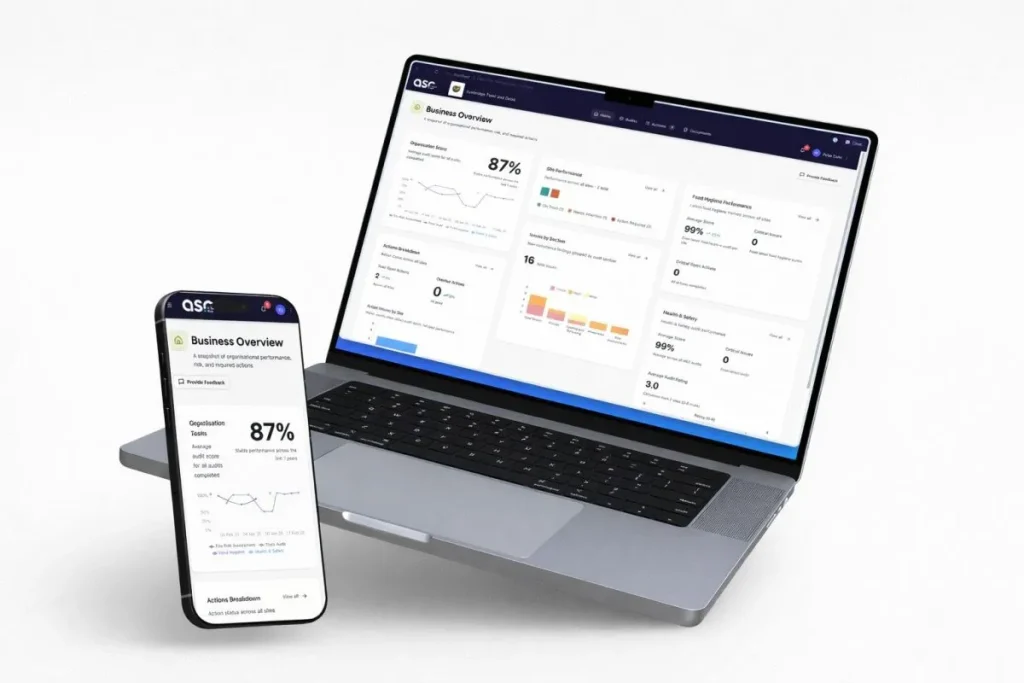
Through A Safer Risk, we have developed a compliance drift score for each site. It is designed to show not only whether a site appears compliant today, but whether its performance may be moving in the wrong direction.
The score can bring together indicators such as missed or retrospectively completed checks, overdue actions, recurring audit findings and changes in performance over time.
For someone responsible for 50 or 100 sites, the priority is not another dashboard showing that everything is green. It is identifying the small number of sites where the pattern is beginning to change, even though nothing serious has happened yet.
A drift score should not be used to judge or rank people, and it does not replace audits, conversations or professional judgement. It acts as an early-warning prompt: something may be changing here, and it is worth looking more closely.
What has quietly become normal?
Compliance is not maintained by policies alone. It is maintained through the decisions people make on ordinary days, especially when the auditor, technical manager or senior leader is not present.
The most useful question may therefore be:
What has quietly become normal in your part of the business that you would challenge if you saw it for the first time today?
You may be the person who can fix it, the person who needs to raise it or the leader who needs to make it easier for someone else to tell you about it.
Recognising drift early gives a business the opportunity to act before a small exception becomes a much larger problem.
To learn more about how Safer Food Scores and A Safer Risk can help you improve visibility across your sites, the team at Safer Food Scores are here to help! Contact us for more info.