
Why the Best Food Safety Training Doesn’t End in the Classroom
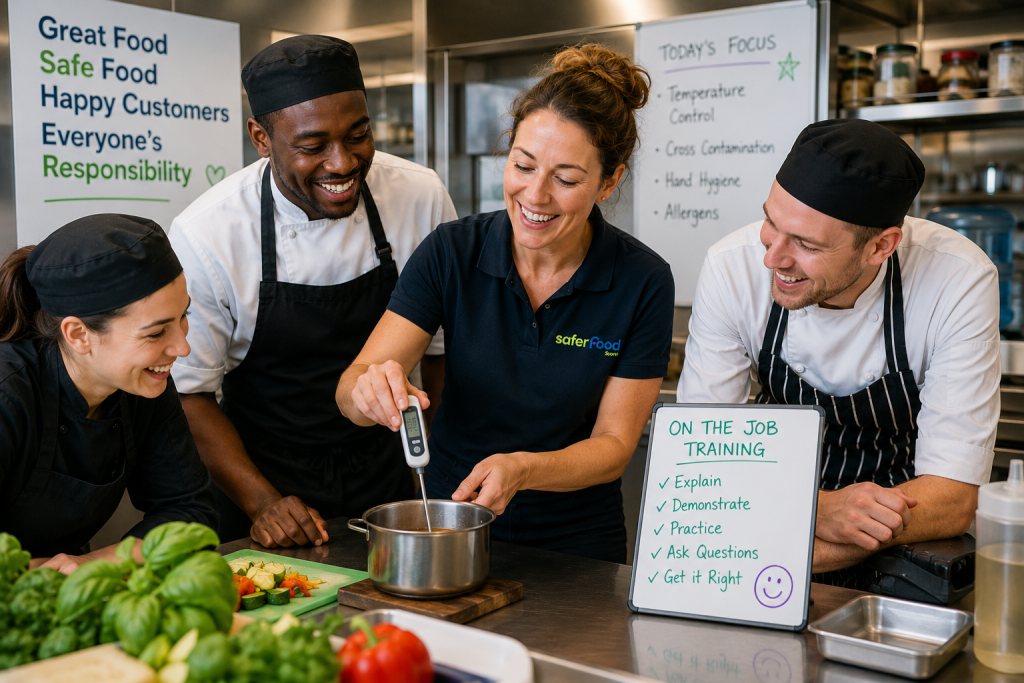
Most people think of food safety training as a classroom, an online course or a certificate on the wall.
All of these have an important role to play.
However, some of the most valuable learning happens somewhere else.
It happens in the workplace.
During conversations.
When someone takes the time to explain not just what needs to change, but why.
In my previous article, I wrote about why recruitment is the foundation of food safety and health & safety. Recruiting people with the right attitude is one of the best investments any business can make.
However, recruitment is only the beginning.
Even the most enthusiastic employee needs support, confidence and the opportunity to develop.
That’s where great food safety training makes all the difference.
Knowledge Is Important. Confidence Is Essential.
Formal food safety training provides employees with the knowledge they need to work safely.
It teaches food hygiene, allergen management, HACCP, temperature control, personal hygiene and legal responsibilities.
For many organisations, particularly larger multi-site businesses, formal training is essential. It provides consistency, demonstrates competence and helps meet legal requirements.
However, knowledge doesn’t always change behaviour.
Confidence does.
An employee may know how to complete a temperature record correctly, but if they don’t understand why it matters or have copied poor habits from someone else, that knowledge can quickly disappear during a busy service.
That’s why practical coaching is so valuable.
There Isn’t Just One Way to Train People
Every business is different.
Some organisations prefer structured classroom training with recognised qualifications and regular refresher courses.
Others, particularly independent businesses and smaller operators, benefit more from practical coaching delivered in their own workplace.
Neither approach is right or wrong.
In our experience, the most effective training combines both.
Formal learning provides knowledge.
Practical coaching builds confidence.
Together, they create competence.
Why We Don’t Just Walk Away After an Audit
Over the years, we’ve completed hundreds of food safety audits.
One thing has become very clear.
Simply identifying problems doesn’t always solve them.
A traditional audit often ends with a report and a list of actions. While that’s important, we’ve found that businesses gain far more when the audit also becomes a learning opportunity.
Rather than simply highlighting an issue, we’ll often stop and explain it.
If a temperature record hasn’t been completed correctly, we’ll demonstrate the correct method.
If allergen controls could be improved, we’ll discuss practical ways to strengthen them within the realities of that business.
If cleaning procedures need refining, we’ll work with the team to identify simple improvements that are realistic and sustainable.
By the time the audit finishes, the business hasn’t just received a report.
The team has learned something.
Behind Every Audit Is a Person
For many people, the word audit creates anxiety.
People worry about being judged.
They worry about finding problems.
They worry about getting things wrong.
We understand those concerns because many of our consultants have worked as Environmental Health Officers within local authorities.
They know what an official inspection looks like because they’ve carried them out.
More importantly, they’ve spent years working with businesses, helping owners, managers and chefs understand legislation, improve standards and prepare for inspections.
That experience shapes the way we work today.
We know what an Environmental Health Officer is looking for because many of our consultants have been one.
However, we also understand the pressures of running a busy food business.
Whether it’s staffing shortages, time pressures or simply trying to keep up with day-to-day operations, we know that behind every audit is a real person doing their best.
That’s why our audits are based on conversation as much as compliance.
We ask questions.
We listen.
We explain.
Most importantly, we work alongside people rather than simply pointing out what’s wrong.
An audit shouldn’t feel like someone trying to catch you out.
It should feel like someone helping you improve.
Adults Learn by Doing
Think back to the best training you’ve ever received.
Was it a PowerPoint presentation?
Or was it someone standing beside you, showing you how to do something properly?
Most adults learn through experience.
They ask questions.
They practise.
They receive feedback.
Then they improve.
That’s exactly why practical coaching works so well.
A five-minute conversation in a kitchen often has far more impact than an hour in a classroom.
Small Conversations Create Big Improvements
Some of the most valuable training sessions last only a few minutes.
Showing someone how to calibrate a thermometer.
Explaining why an allergen label matters.
Helping a new supervisor understand why daily monitoring protects both customers and the business.
Demonstrating the safest way to complete a task.
These aren’t formal training courses.
Yet they’re often the moments people remember.
Because they’re practical.
They’re relevant.
And they happen exactly when they’re needed.
Great Managers Coach Every Day
Food safety training shouldn’t only happen during induction.
It should happen every day.
The best managers don’t simply check whether a task has been completed.
They explain why it matters.
They answer questions.
They encourage curiosity.
They recognise good practice.
Over time, those small conversations create a culture where learning becomes part of everyday work.
That’s when food safety stops being something people think about only during an inspection.
It simply becomes the way the business operates.
Better Training Builds Better Food Safety Culture
Food safety culture isn’t created by policies.
It isn’t created by checklists.
It isn’t created by certificates alone.
It’s created by people who understand why standards matter and feel confident enough to maintain them every day.
Recruitment finds those people.
Training develops them.
Leadership supports them.
Together, they create safer businesses.
Final Thoughts
Food safety training should never be viewed as a one-off event.
Formal training will always have an important role.
However, practical coaching, supportive audits and everyday conversations are often where the biggest improvements happen.
At Safer Food Scores, that’s why we don’t simply complete an audit and walk away.
We share knowledge.
Help to answer questions.
Coaching staff and sharing knowledge.
Because the best audits don’t just measure standards.
They leave people feeling more confident than when they arrived.
Frequently Asked Questions
1. How can I improve my food hygiene rating?
The good news is you are already on your first step to doing just that. If you are reading this we are on hand to help. Send us your report or give us a call and we can offer some free advice to get you started.
Hello@saferfoodscores.co.uk
or fill out our Contact us form.
2. Why is food safety training important?
Food safety training gives employees the knowledge and confidence to prepare, handle and serve food safely while meeting legal food hygiene requirements. It also helps businesses comply with food safety legislation and protect their customers.
3. Is on-the-job food safety training effective?
Yes. Practical coaching allows employees to learn while carrying out their normal duties. Most people retain information better when they can immediately apply it in a real working environment.
4. Why combine food safety audits with training?
Combining audits with coaching helps employees understand why improvements are needed rather than simply being told what to change. This often leads to stronger long-term compliance and a more positive food safety culture.
5. Who delivers food safety audits at Safer Food Scores?
Many of our consultants have backgrounds in Environmental Health and Food Safety. Their experience allows them to combine technical knowledge with practical advice that works in real businesses.
6. How often should food safety training be refreshed?
Training should begin during induction and continue throughout employment. Regular coaching, refresher training and supportive audits help reinforce good practice and maintain high standards.
7. Can small businesses benefit from on-the-job training?
Absolutely. Smaller operators often find practical coaching particularly valuable because it can be tailored to their business, their team and the way they work.